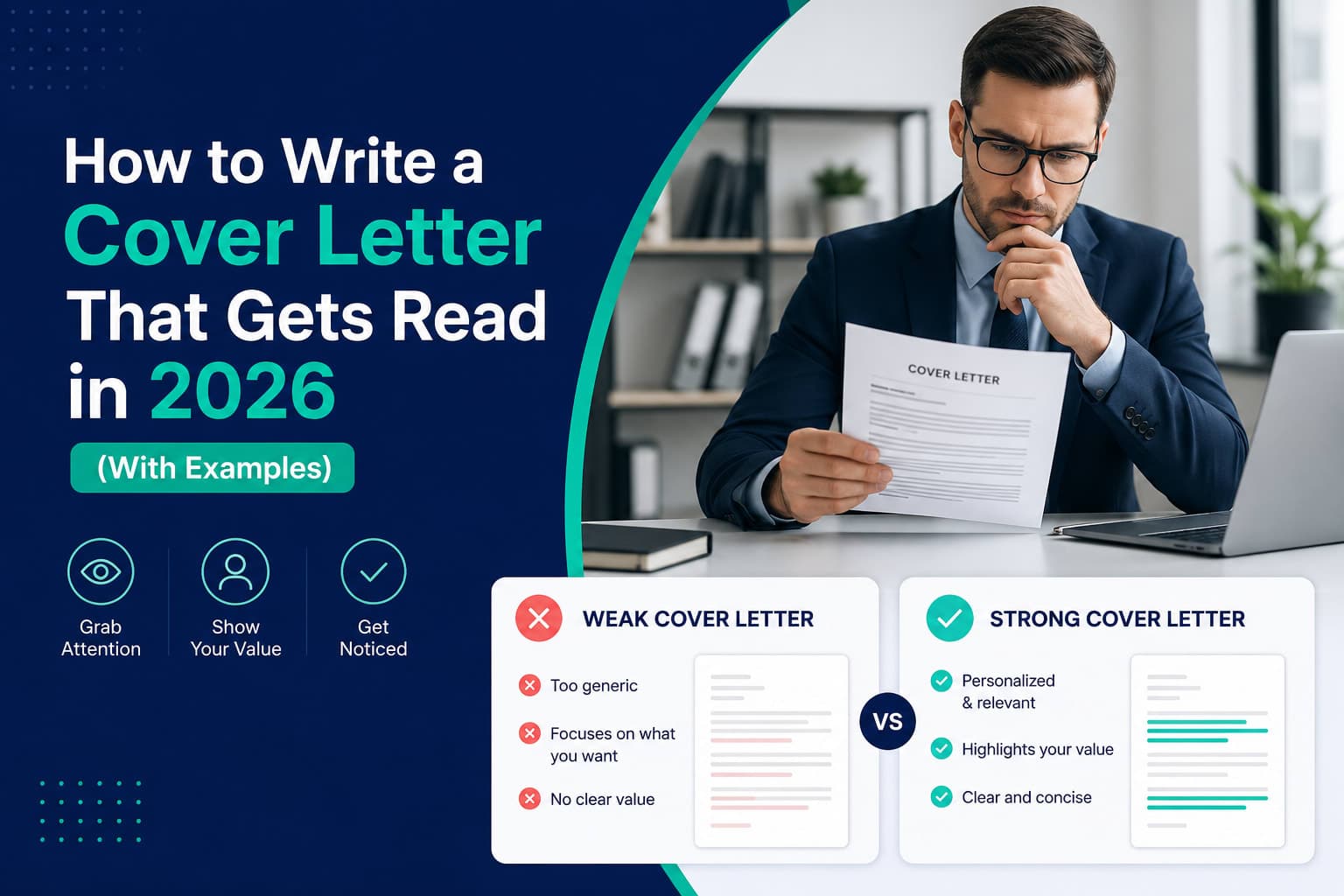
How to Write a Cover Letter That Gets Read in 2026 (With Examples)
Most cover letters never get read past the first line. To write a cover letter that gets read, you have to do the opposite of what most applicants do: stop summarizing your resume and start giving the recruiter a reason to keep going. This guide shows you the structure, the exact wording, and real examples you can adapt in twenty minutes.
The problem isn't that cover letters don't work. It's that most are generic, repetitive, and so focused on the applicant that they say nothing useful to the employer. Fix that, and a cover letter becomes the most persuasive tool in your application.
Featured snippet target: To write a cover letter that gets read, keep it to one page and three or four short paragraphs. Open with a specific reason you fit the role — never "I am writing to apply." Connect two or three achievements directly to the job description, explain why you want this company, and close with a confident call to action. Recruiters read letters that speak to their needs, not yours. (54 words)
What a Cover Letter Is Actually For
A cover letter is not a summary of your resume. If it repeats what's already on the page, you've wasted the recruiter's time and your own.
A cover letter does four things a resume can't:
Explains why you want this specific role at this specific company
Connects your past experience to the employer's current needs
Shows your personality and how you communicate
Addresses anything unusual — an employment gap, a career change, a relocation
Think of it as the human layer on top of your structured resume data.
The Right Length and Format
One page. No exceptions. Three to four short paragraphs is the ideal. Dense blocks of text lose the reader in seconds.
Format checklist:
Standard business letter layout
Same font and header style as your resume, for a consistent look
10–12pt font size, 0.75–1 inch margins
Addressed to a named person whenever possible — "Dear Ms. Patel" beats "To Whom It May Concern" every time
Saved as a PDF, named clearly:
FirstName-LastName-CoverLetter.pdf
💡 Tip: Match your cover letter's header exactly to your resume header — same name styling, same font, same contact layout. When both documents look like one set, recruiters read you as organized before they've read a word.
The Four-Part Structure That Gets Read
Part 1: The Hook (Opening Paragraph)
Never open with "I am writing to apply for the position of…" That sentence has been written millions of times and tells the reader nothing. Instead, open with a concrete reason this role or company caught your attention.
Example:
"Your recent expansion into Southeast Asian markets is exactly the kind of growth challenge I've spent the last four years preparing for. As a regional marketing manager who has scaled campaigns across five markets, I'd like to bring that experience to [Company]."
This shows you've done your research and have something relevant to offer — in the first two lines.
Part 2: What You Bring (The Value Paragraph)
Connect your experience to the role's requirements. Pick two or three of your most relevant achievements and frame them as outcomes, not tasks. Numbers beat adjectives.
Example:
"In my previous role, I led a content-led demand generation programme that cut cost per lead by 34% over 12 months. I also managed a team of three strategists and introduced a quarterly editorial calendar that improved publishing consistency by 60%. These are exactly the kinds of initiatives your job description highlights as priorities."
The phrase doing the work: "your job description highlights as priorities." Tie your experience explicitly back to their needs.
Part 3: Why This Company (The Fit Paragraph)
Explain why you want to work here specifically. Generic enthusiasm — "I've always admired your company" — lands nowhere. One researched, specific reason beats a full paragraph of vague praise.
Example:
"What draws me to [Company] in particular is your commitment to building genuinely accessible tools. I've followed your product blog for over a year, and the way your team approaches UX decisions — start with the user, then build backward — mirrors how I think about marketing strategy."
Even one sentence of real specificity beats a paragraph of filler.
Part 4: The Close (Call to Action)
End with confidence. Don't apologize for taking their time. Don't say "I hope to hear from you." State that you'd welcome a conversation and make follow-up easy.
Example:
"I'd welcome the chance to discuss how my background in growth marketing could support [Company]'s next phase. I'm available for a call at your convenience, and my resume and portfolio are attached for reference. Thank you for your time."
Writing a Cover Letter for a Career Change
If you're switching industries, the recruiter's silent question is: why should I take a chance on someone from a different field? Answer it directly. Name the transferable skills and reframe your experience in the language of the new role.
Example:
"After six years managing complex construction schedules, I'm moving into project management in software delivery. The core skill is the same — sequencing dependencies, managing stakeholders, and hitting deadlines under pressure — and I'm now applying it to a field I've been building toward deliberately."
Don't hide the change. Own it, and show it's intentional.
Common Mistakes That Stop Your Letter Getting Read
Starting with "I." It centers the letter on you, not the employer. Restructure so the company, the role, or a shared goal leads the first sentence.
Copying resume bullets. The letter must add new context, not repeat data.
Wrong tone for the company. Match it — a startup letter can be warmer; a law firm expects formality.
Not addressing a name. Check LinkedIn, the company site, or the posting. A 30-second search is worth it.
Going over one page. If it runs long, cut it. Every sentence should earn its place.
Does Every Application Need a Cover Letter?
No — but it helps more often than it hurts. If the field is optional and you have a strong tailored letter ready, include it. If you're applying to dozens of roles a day, prioritize writing strong letters for the roles you most want, rather than blasting generic ones everywhere. A targeted cover letter takes 20–30 minutes to write well. For the right opportunity, that's time well spent.
Frequently Asked Questions
How do I start a cover letter that gets read?
Open with a specific reason you fit the role or admire the company — not "I am writing to apply." Reference something concrete about the company or a relevant achievement of yours in the first two lines, so the recruiter has a reason to keep reading.
How long should a cover letter be in 2026?
One page maximum, three to four short paragraphs. For online application text boxes, four to six tight lines often work better than a full letter. Recruiters skim, so front-load your strongest point.
Should a cover letter repeat my resume?
No. A cover letter should add context your resume can't show — why you want the role, how your experience maps to their needs, and any explanation for a gap or career change. Repeating bullet points wastes the reader's time.
Do recruiters still read cover letters?
When a cover letter is included, it usually gets read — and a strong, tailored one moves candidates forward. Generic letters sent in bulk perform worse than a few well-targeted ones written for roles you genuinely want.
How do I write a cover letter with no experience?
Lead with transferable skills, coursework, projects, internships, and measurable results from any setting — volunteering, freelance, or academic. Show enthusiasm for the specific role and connect what you've done to what the job needs.
Pair Your Cover Letter With a Matching Resume
A strong cover letter attached to a mismatched resume sends a mixed signal. Your typography, spacing, and header should look like they came from the same professional.
Build both in one place. EZProCV's cover letter builder is paired with its resume templates, so your fonts, spacing, and layout stay consistent across both documents — giving your application a polished, cohesive look from the first page to the last.
Your cover letter isn't a formality. Used well, it's the most persuasive tool in your job application. Keep it to one page, make it specific, and let genuine interest in the role come through in every line.
