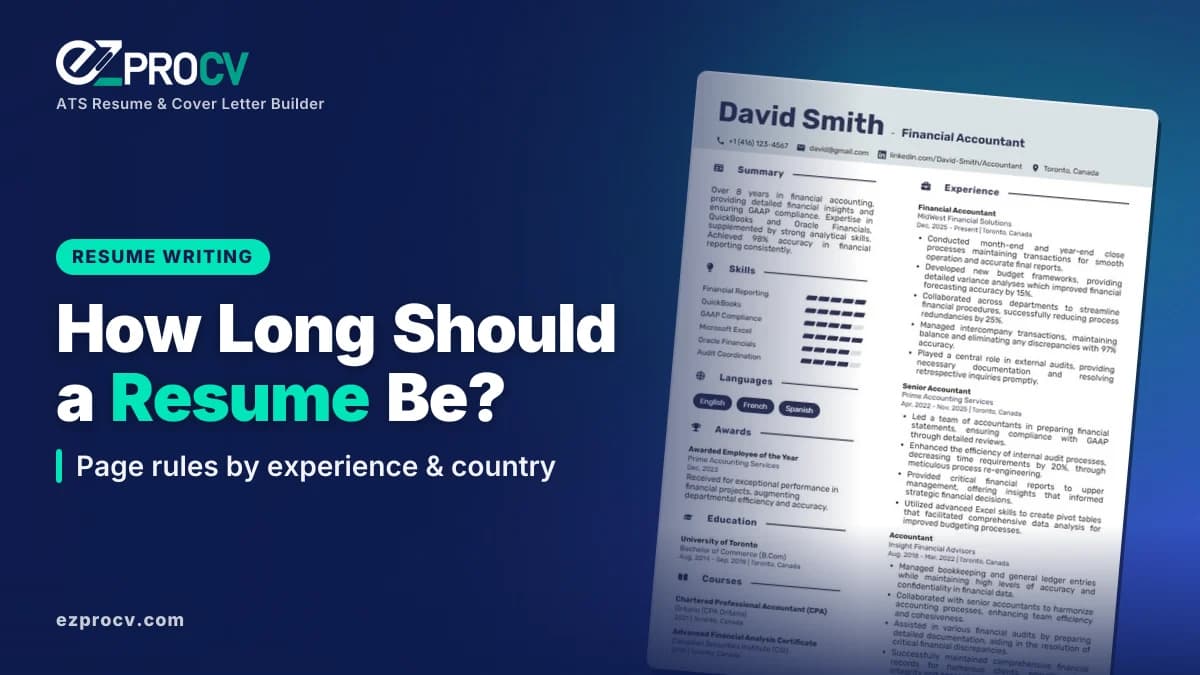
Quick answer: Most resumes should be one or two pages. Use one page if you're a student, new graduate or have under about five years of relevant experience. Use two pages if you have more experience that is relevant to the job. UK, European and Gulf CVs are usually two A4 pages. Only academic CVs and some senior or federal roles have different rules.
"How long should a resume be?" is one of the first questions people ask, and the honest answer is: as long as your relevant experience needs, and no longer. For most people that means one page or two.
This guide gives you clear rules by career stage, a table showing how the norm changes between the US, Canada, the UK, Europe, the Gulf, India and Australia, the exceptions (academic CVs and US federal jobs), and a step-by-step method to cut a resume that has grown too long.
How long should a resume be? The short rule
Aim for one page if you're early in your career and two pages once you have several years of relevant experience. Go beyond two pages only for academic, research or certain government applications.
That matches advice from career services on both sides of the Atlantic. MIT's career office tells students to "aim for one page or two pages maximum if you have substantial relevant information" (MIT CAPD). Canada's government-run Job Bank says simply: limit your resume to two pages.
Resume length by years of experience
| Your experience | Recommended length | What fills the space |
|---|---|---|
| Student or school leaver | 1 page | Education, part-time jobs, projects, activities |
| New graduate (0–2 years) | 1 page | Degree, internships, projects, skills |
| Early career (2–5 years) | 1 page, 2 if all relevant | 2–3 roles with quantified bullets |
| Mid-career (5–10 years) | 2 pages | Recent roles in detail, older ones shortened |
| Senior (10–20 years) | 2 pages | Last 10–15 years in detail, earlier roles in one line each |
| Executive | 2 pages, occasionally 3 | Leadership results, board or P&L scope |
| Academic or research | No fixed limit | Publications, grants, teaching, presentations |
The deciding question isn't "how many years?" but "how much of this is relevant to the job I'm applying for?" Seven years in an unrelated field might still fit on one page.
Does resume length change by country?
Yes. The word "resume" or "CV", the paper size and the expected length all vary.
| Region | Common name | Usual length | Notes |
|---|---|---|---|
| United States | Resume | 1 page (early career), 2 pages (experienced) | Letter-size paper; federal jobs have a 2-page limit |
| Canada | Resume | 1–2 pages | Job Bank: limit to two pages |
| UK and Ireland | CV | 2 sides of A4 | 1 side is fine for part-time or school-leaver roles |
| Europe (incl. Europass) | CV | 1–2 pages | Focus on the facts that match the job |
| Gulf (UAE, Saudi Arabia, Qatar) | CV | 2 pages, 3 for senior roles | Personal details (photo, nationality, visa status) take extra space |
| India and Pakistan | Resume or CV | 1 page (freshers), 2–3 (experienced) | Avoid long "biodata" personal sections |
| Australia and New Zealand | Resume | 2–3 pages for experienced candidates | Referees often listed at the end |
A few notes behind the table:
- UK: The University of Sheffield's careers service says that "for most placement and graduate roles two sides of A4 is the norm", and that a one-side CV is fine for most part-time jobs (University of Sheffield).
- Europe: The EU's Europass guidance doesn't set a page limit but advises: "Do not include a full detailed history." Focus on the points that match the job.
- US federal jobs: As of October 2026, the US Office of Personnel Management has set a two-page limit on resumes for federal job applications. Always confirm the rule in the specific announcement on USAJOBS before you apply.
- Australia: Australian government careers resources describe a resume as a short document of one to two pages (Veterans' Employment Program), though experienced candidates commonly run to three. Check the job ad: some employers state a limit.
For more detail, see our guides to the USA resume format, the UK CV format, the India CV format and the resume format for UAE jobs, or browse every country in the CV format hub.
When is a one-page resume the right choice?
Choose one page when:
- You're a student, graduate or have under about five years of experience.
- You're changing careers and most of your past roles aren't relevant.
- The job ad asks for a "one-page resume" (common for US internships and some consulting or finance roles).
- You're handing a resume over at a job fair, where readers skim in seconds.
Example of a well-filled one-page structure for a graduate:
Name and contact details (3 lines)
Summary (3 lines)
Education (4 lines, including relevant modules or GPA if strong)
Experience: internship and part-time job (8–10 bullets)
Projects (2 entries)
Skills (2 lines)
When should a resume be two pages?
Two pages are better when:
- You have more than about five years of experience that relates to the job.
- You hold certifications, licenses or technical skills that employers screen for, such as nursing registrations, engineering licenses or cloud certifications.
- You're applying in the UK, Europe, the Gulf or Australia, where two pages is the default for experienced candidates.
Put your strongest material on page one: summary, current role and key skills. Many readers decide whether to turn the page based on the first half of page one. Add your name and page number to page two so it isn't lost if printed.
Can a resume be three pages or longer?
Rarely. A three-page resume makes sense for:
- Academic and research CVs. MIT's career office notes that an academic CV is typically 2 to 4 pages for a younger professional and 4 to 7 pages for someone with more experience (MIT CAPD).
- Senior executives and some technical specialists with long project lists, where every entry is relevant.
- Gulf and Australian applications for very senior roles, where a third page is more accepted.
For everyone else, a third page usually means old or irrelevant detail that should go.
How to cut your resume to the right length
- Delete roles older than about 15 years or shrink them to one line each. Job Bank advises minimizing or removing jobs more than 15 years old.
- Cap bullets per role: 4–6 for your current job, 2–3 for older ones.
- Rewrite bullets to one or two lines. Lead with an action verb and a result.
- Merge short or similar jobs under one heading, such as "Freelance design projects (various clients)".
- Remove "References available on request", hobbies with no link to the job and your full street address.
- Shorten the summary to three lines; see our resume summary examples.
- Fix layout, not font size: tighten spacing between sections before shrinking text.
Before and after a typical cut:
Before: Responsible for managing the day-to-day operations of the customer service department, including supervising staff, handling escalated complaints and preparing weekly reports for senior management.
After: Led a 12-person customer service team; cut escalations by 30% and delivered weekly performance reports to senior management.
Common mistakes with resume length
- Squeezing everything onto one page with 8-point text and narrow margins.
- Padding a short resume with generic skills and an objective that says nothing.
- Leaving page two almost empty: half a page is fine; three lines is not.
- Keeping every job you've ever had instead of the ones that matter for this role.
- Ignoring the job ad. If it says "maximum two pages", a third page may be discarded unread.
Build it in EZProCV
EZProCV's resume templates show a live preview that matches the downloaded PDF, so you can see exactly where page one ends while you edit. Adjust fonts, colors and spacing to land on a clean one or two pages, then download a free, text-based PDF that applicant tracking systems can read. Already have a long resume? Import the PDF or DOCX and trim it in place.
Sources
- Job Bank Canada: How to write a good resume
- MIT CAPD: Crafting an effective resume and How to write a CV
- University of Sheffield Careers Service: Writing a CV
- Europass: Create your Europass CV
- US Office of Personnel Management: Agency guidance on the two-page limit on resume length
- National Careers Service: CV sections
Frequently asked questions
Is a one-and-a-half page resume okay?
Yes. A resume that fills about one and a half pages is fine, and it's better than cramming everything onto one page with tiny margins or padding it to reach two. Just make sure the second page starts with real content, such as an older role or your education, and not a lone heading or two orphaned lines.
Does resume length matter for applicant tracking systems?
An applicant tracking system (ATS) stores and searches your resume text, so an extra page doesn't hurt it. Length matters for the human who reads the resume afterwards. What does affect the software is layout: MIT's career office warns that ATS may struggle with tables, columns, graphics and images, so keep the design simple whatever the length.
Should I shrink the font to fit my resume on one page?
Not below about 10 to 11 points for body text. UK careers services commonly suggest a clear font at size 11 or bigger. Shrinking the font or margins makes the resume harder to read, especially on a phone. Cut words instead: shorten bullets, drop older roles and remove the references line.
How long should a resume be for a career changer?
Usually one page, or two if your earlier career has strong transferable results. Career changers often have lots of experience that doesn't match the new role, so summarize older or unrelated jobs in one or two lines each and give the space to transferable achievements, new training and relevant projects.
Does a cover letter count toward resume length?
No. The cover letter is a separate document, usually one page on its own. Don't attach it as page one of your resume file unless the application allows only one upload, and in that case put the letter first and clearly label both parts.