Quick answer: A modern resume is a one- or two-page document with your name and contact details at the top, then a short headline and summary, work experience in reverse chronological order with bullet points, a skills section and education. It uses one clear font at 10–12 points, a single column, standard headings, consistent dates and plenty of white space, with no photo in the US, UK or Canada.
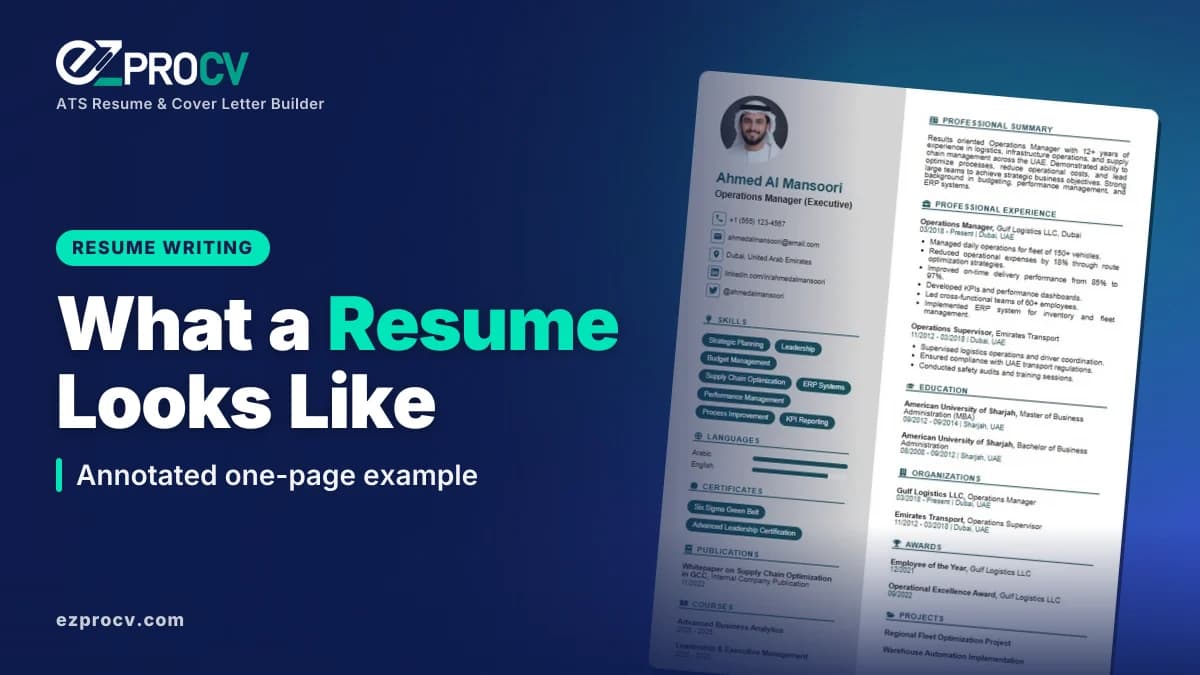
If you're writing your first resume, or your last one dates from a decade ago, it helps to know exactly what the finished document should look like before you start typing. What does a resume look like today? Simpler than most people expect: one or two pages, one column, clear headings and short bullet points, with nothing a reader has to decode.
Below you'll find a full one-page example annotated from top to bottom, a section-by-section breakdown of what each part contains and why, the layout specs recruiters expect (font, size, margins, length), how the same resume changes for the US, UK, Gulf and India, and a list of visual dos and don'ts.
What does a resume look like at a glance?
Picture a single page, read top to bottom, with five blocks:
- Header: your name in larger type, with contact details on one or two lines below it
- Headline and summary: a one-line title and two to four lines on who you are and what you offer
- Experience: each job with title, employer, location and dates, followed by three to six bullet points
- Skills: a short, grouped list of job-relevant skills
- Education: degree, institution and year, plus certifications if relevant
Optional sections (projects, volunteering, languages, awards) go at the end, or above experience if they're your strongest material.
MIT's career office sums up the conventions: "you'll always start with your contact information at the top of the document," and you should "aim for one page or two pages maximum if you have substantial relevant information" (MIT CAPD).
Sample resume: one page, top to bottom
Here's a complete one-page resume for an accountant with five years' experience. Read it once as a recruiter would, then see the annotations in the next section.
Daniel Okafor
Toronto, ON · (416) 555-0148 · daniel.okafor@email.com · linkedin.com/in/danielokafor
Senior Staff Accountant | Month-End Close, IFRS, NetSuite
CPA-qualified accountant with 5 years in manufacturing and distribution. Shortened month-end close from 9 to 5 working days and led the finance side of a NetSuite migration. Looking to bring process improvement and audit-ready reporting to a growing finance team.
EXPERIENCE
Staff Accountant, Brightline Distribution Inc., Toronto, ON | Mar 2023 – Present
- Own month-end close for 3 entities; cut close time from 9 to 5 days by automating accruals and bank reconciliations
- Prepare IFRS financial statements and audit schedules; external audit closed with no adjustments for 2 consecutive years
- Led finance testing for NetSuite migration, mapping 1,400 general ledger accounts with zero post-launch reporting errors
- Train and review work of 2 junior accountants
Junior Accountant, Mapleworks Manufacturing Ltd., Mississauga, ON | Jun 2021 – Feb 2023
- Processed 600+ supplier invoices a month with a 99% on-time payment rate
- Built an Excel variance report that flagged CAD 85K in duplicate payments in the first quarter of use
- Reconciled intercompany accounts across Canada and US subsidiaries
SKILLS
Accounting: month-end close, IFRS, accruals, reconciliations, audit preparation · Systems: NetSuite, QuickBooks, advanced Excel (pivot tables, XLOOKUP, Power Query), Power BI · Languages: English (native), Yoruba (fluent)
EDUCATION AND CERTIFICATIONS
CPA (Chartered Professional Accountant), CPA Ontario | 2024
Bachelor of Commerce, Accounting, Toronto Metropolitan University | 2021
That's a resume that fits on one letter-size page with comfortable margins. Our accountant resume example shows a fully designed version.
Section-by-section: what each part of a resume looks like
The header
Name in the largest type on the page (about 18–24 points), then city and country, phone, email and a LinkedIn or portfolio link. Keep it in the body of the page, not in the document's header area: Greenhouse's help center lists contact details placed in a header, footer or text box as a reason a resume fails to parse (Greenhouse Support). Don't write "Resume" or "CV" as a title; Prospects advises using your name as the title instead (Prospects).
The headline
One line, in bold, naming the role you're targeting and two or three keywords. It tells a skimming recruiter in a second what kind of candidate you are.
The summary
Two to four lines, no "I," no clichés. Who you are, your best relevant result and what you're aiming for.
Work experience
Each role has the same layout: job title, employer, location, dates on one or two lines, then bullets. Harvard advises listing information within each heading "in reverse chronological order (most recent first)" (Harvard FAS Career Services). Canada's Job Bank suggests limiting each section or subsection to 5–7 bullet points (Job Bank). Each bullet starts with an action verb and, where possible, ends with a result.
Skills
A few lines of grouped, job-specific skills. No rating bars or stars, which carry no information a recruiter can use and may not survive parsing.
Education and certifications
Degree, subject, institution and year. Add your grade only if it's strong and recent. Certifications go here or in their own section, named exactly as the issuer names them.
Optional sections
Projects, volunteering, languages, awards, publications. Include them when they add evidence for this job, not to fill space.
What should a resume look like visually?
| Element | What it should look like |
|---|---|
| Length | 1 page (students, early career) or 2 pages (experienced) |
| Paper size | US Letter in the US and Canada; A4 almost everywhere else |
| Font | One clear font, such as Arial, Calibri, Garamond or Times New Roman |
| Font size | 10–12 pt for body text, 14–16 pt for headings, larger for your name |
| Margins | At least 0.5 in (1.27 cm), ideally 0.75–1 in (about 2–2.5 cm) |
| Layout | Single column, left-aligned text, consistent spacing |
| Headings | Standard names: Experience, Skills, Education |
| Dates | One format throughout (Mar 2023 – Present) and right-aligned or consistent placement |
| Color | Black text; at most one accent color for name and headings |
| File | Text-based PDF unless the employer asks for Word |
The UK's National Careers Service recommends "a clear font like Arial, Times New Roman or Calibri in size 11 or bigger" and to "always use the same style throughout" (National Careers Service). MIT suggests margins of "at least 0.5 inches, ideally 0.75 inches."
What does a resume look like in different countries?
The core layout above works almost everywhere. What changes is length, paper size and personal details.
| US and Canada | UK and Ireland | UAE, Saudi Arabia, Qatar | India and Pakistan | |
|---|---|---|---|---|
| Usual name | Resume | CV | CV | Resume or CV |
| Length | 1–2 pages | 2 A4 pages | 2 pages, 3 for senior roles | 1 page (freshers), 2 (experienced) |
| Photo | No | No | Common, often expected | Optional; increasingly omitted |
| Date of birth, marital status | No | No | Often included | Sometimes included; not necessary |
| Nationality, visa status | Work authorization only if relevant | Right to work if relevant | Usually included, with notice period | Usually not needed for local jobs |
| References | "Available on request" omitted | Often omitted or one line | Sometimes listed | Sometimes listed |
A few notes:
- UK: Prospects quotes the University of Chester careers team: "We recommend CVs are no longer than two A4 pages." The National Careers Service says you shouldn't include your age, date of birth, marital status or nationality.
- Gulf: Employers commonly expect a photo, nationality, visa status and notice period near the top. Our UAE resume format guide shows exactly where they go.
- India and Pakistan: Many older resumes end with a long personal profile or "biodata" and a signed declaration. For most private-sector and multinational employers today, a short professional resume without those sections looks more current. Check the India CV format for details.
See all our CV formats by country for the local conventions where you're applying.
Visual dos and don'ts
| Do | Don't |
|---|---|
| Use one column and standard headings | Use tables, text boxes or multiple columns for main content |
| Keep one font and one bullet style | Mix three fonts or use decorative bullets |
| Leave white space between sections | Shrink margins below 0.5 in to fit more |
| Bold job titles or employers consistently | Bold random words in bullets |
| Use one accent color | Use colored backgrounds or light gray text |
| Write skills as words | Show skills as bars, stars or pie charts |
| Save as a text-based PDF | Send a scanned image or screenshot of your resume |
MIT warns that applicant tracking systems "may struggle with reading tables, columns, graphics, and images," and recommends "standard bullet points, like traditional round bullet points."
Common mistakes
- Starting with an "Objective" that talks about what you want. A summary about what you offer works better.
- Wall-of-text paragraphs under each job instead of bullets.
- Inconsistent formatting: dates in three styles, headings in two sizes.
- Personal details that don't belong in your target country (or missing ones that do, in the Gulf).
- Design over substance: an eye-catching template can't hide duty-based bullets. Our guide on how to make a resume stand out covers the content side.
- Image-based files that look fine to you but can't be read by software.
Build it in EZProCV
Choose one of the ATS-friendly resume templates and fill in each section; the live preview shows exactly what the downloaded file will look like. You can adjust fonts, colors and spacing, switch on optional Gulf fields (photo, nationality, visa status, notice period) and download a text-based PDF free. For ideas, browse the resume examples by job.
Sources
- MIT CAPD: Crafting an effective resume
- Harvard FAS Career Services: Create a strong resume
- National Careers Service: CV sections
- Prospects: How to write a CV
- Greenhouse Support: Unsuccessful resume parse
- Job Bank (Government of Canada): Write a good resume
Frequently asked questions
What does a resume look like for a first job?
The same layout, with a different order. Put education right after the summary, then any part-time work, volunteering, projects and activities, then skills. Keep it to one page. MIT's career office notes that early-career resumes typically place education next after contact information, because it's often your strongest qualification at that stage.
Should a resume have a photo?
Not in the US, Canada, the UK or Ireland, where photos are generally left off to avoid bias. Prospects, the UK graduate careers site, says you don't need one unless you're applying for acting or modeling work. Photos are common and often expected in the UAE, Saudi Arabia and Qatar, and in parts of Europe and Asia. Follow the local norm or the job ad.
Can a resume have two columns?
It can, but a single column is safer. Two-column layouts can be read in the wrong order by applicant tracking systems; Greenhouse and MIT both flag columns as a parsing risk. If you like a sidebar look, keep the main content in one column and confine the sidebar to short items, or use a single-column template with a strong header instead.
What should a resume file be called?
Use your name and the document type, for example "Priya-Sharma-Resume.pdf" or "Priya-Sharma-CV.pdf". Avoid names like "resume-final-v3.pdf" or "document1.pdf", which look careless and are hard for a recruiter to find again. If the job ad asks for a reference number in the file name, add it at the end.
Is a resume the same as a CV?
It depends on the country. In the US and Canada, a resume is the one- or two-page job document and a CV is a longer academic record. In the UK, Ireland, Europe, the Gulf, South Asia and Africa, "CV" is the normal word for the job document, and it looks much like the resume described here, often running to two pages.