Quick answer: Resume keywords are the job titles, hard skills, tools, certifications and qualifications an employer lists in a job ad and searches for in applications. To find them, highlight every requirement in the ad, group repeated terms, and copy their exact wording into your summary, skills section and experience bullets. Use each keyword where you can prove it; never paste lists you can't back up.
Resume keywords are the words a recruiter types into a search box when looking for someone like you: job titles, skills, software, certifications and qualifications. If those words aren't on your resume in a form the employer recognizes, you can be a perfect fit and still not show up.
This guide shows you how to pull the right keywords out of any job ad in about ten minutes, where to place them, how much is too much, and five worked examples from different fields. It builds on our guide to making your resume ATS-friendly, which covers layout and file format.
What are resume keywords?
Resume keywords are the specific terms in a job description that describe what the employer needs. They fall into a few groups:
- Job titles: "Staff Accountant", "Registered Nurse", "Scrum Master"
- Hard skills: budgeting, wound care, SQL, contract negotiation
- Tools and software: Salesforce, SAP, AutoCAD, Epic, Power BI
- Certifications and licenses: PMP, CPA, ACCA, CompTIA Security+, RN license
- Qualifications: "Bachelor's degree in civil engineering", "5+ years in B2B sales"
- Industry terms: IFRS, GDPR, HACCP, SaaS, FMCG
Soft skills like "communication" and "leadership" also appear in ads, but recruiters search for them far less often than the hard terms above.
How do recruiters use keywords to search resumes?
Most medium and large employers use an applicant tracking system (ATS), software that stores applications and lets recruiters search and filter them. The search tools are often simple and literal.
The ATS vendor Greenhouse, for example, documents a Talent Filtering feature that searches "the full text of resumes and internal notes". Recruiters can mark terms as Preferred, where only one term must appear, or Required, where all terms must appear in an application for it to show in the results (Greenhouse Support). Greenhouse also offers keyword suggestions that are generated from the job description itself (Greenhouse Support).
Two practical lessons follow:
- The job ad is your keyword list. If the system suggests filters from the description, the description's wording is what you should mirror.
- The text has to be readable. MIT's career office warns that an ATS "may struggle with reading tables, columns, graphics, and images" (MIT CAPD). A keyword inside a graphic may as well not exist.
How to find resume keywords in a job ad: step by step
- Copy the job ad into a document. Include the responsibilities, requirements and "nice to have" sections.
- Highlight every noun or noun phrase that names a skill, tool, qualification or title.
- Mark repeats. Terms that appear twice or more, or in both the title and requirements, are your top priority.
- Split must-haves from nice-to-haves. Requirements under "Essential" or "You must have" come first.
- Note the exact wording. If the ad says "Microsoft Excel (advanced)", don't write "spreadsheets". If it says "Customer Success Manager", don't title yourself "Client Happiness Lead".
- Add both forms of acronyms once: "Search Engine Optimization (SEO)", "Certified Public Accountant (CPA)".
- Check two or three similar ads. Terms that appear across several employers are core keywords for that job title.
- Fill gaps with O*NET. The US Department of Labor's O*NET OnLine lists skills, knowledge and software for more than 900 occupations, which helps you spot standard terms for your role.
- Match each keyword to proof. Next to each term, write where on your resume you can show it. Terms with no proof don't go in.
The University of Sheffield's careers service gives the same advice in plain terms: use "the same keywords the employer has used to help them find what they are looking for" (University of Sheffield).
Hard keywords vs soft keywords
| Type | Examples | How to use them |
|---|---|---|
| Hard skills | Financial modeling, phlebotomy, Python | Skills section and experience bullets |
| Tools | Salesforce, Xero, Jira, Revit | Skills section; name the tool in the bullet where you used it |
| Certifications | PMP, CIPD Level 5, BLS | Dedicated certifications section, with year |
| Job titles | "Payroll Specialist" | Your headline, summary and matching past titles (if accurate) |
| Soft skills | Stakeholder management, coaching | Prove in a bullet; avoid one-word lists |
Where should you put keywords on your resume?
Spread them across the sections a recruiter reads and an ATS indexes:
- Headline and summary: the job title and your top two or three skills. See our resume summary examples for keyword-rich openers.
- Skills section: a clean list of hard skills and tools, grouped if long.
- Experience bullets: the strongest place, because the keyword sits next to evidence.
- Certifications and education: use official names and abbreviations.
Example of a keyword used with proof:
Weak: Skills: Power BI, SQL, stakeholder management
Strong: Built 6 Power BI dashboards from SQL data models, used by regional managers to cut stock-outs by 18%.
What is keyword stuffing and why does it backfire?
Keyword stuffing means repeating terms or pasting the job ad into your resume to "beat" the system. It backfires because a person reads the resume after the search. A skills section with 40 terms, or the same tool named eight times, looks careless or dishonest, and interviewers will ask about every skill you listed.
A good test: could you talk for two minutes about every keyword on your resume? If not, remove it.
5 worked examples of resume keywords by field
1. Data analyst
Ad extract: "Advanced SQL, Power BI or Tableau, Python a plus, stakeholder reporting, A/B testing."
Keywords: SQL, Power BI, Tableau, Python, A/B testing, dashboards, stakeholder reporting, data visualization
Bullet: Wrote SQL queries and Power BI dashboards for weekly stakeholder reporting; designed A/B tests that lifted email sign-ups by 12%.
See the full data analyst resume example.
2. Registered nurse
Ad extract: "Active RN license, BLS and ACLS, telemetry experience, Epic EHR, patient education."
Keywords: Registered Nurse, RN license, BLS, ACLS, telemetry, Epic, patient education, care planning
Bullet: Monitored telemetry for up to 6 cardiac patients per shift, documented care plans in Epic, and delivered discharge education.
More in the nurse resume example.
3. Project manager (construction)
Ad extract: "PMP preferred, Primavera P6, budget control, subcontractor management, HSE compliance."
Keywords: Project Manager, PMP, Primavera P6, budget control, subcontractor management, HSE, scheduling, risk management
Bullet: Managed AED 18M fit-out with Primavera P6 scheduling and weekly budget control; coordinated 9 subcontractors with zero HSE incidents.
4. Accountant
Ad extract: "ACCA or CPA, month-end close, IFRS, reconciliations, SAP, VAT returns."
Keywords: ACCA, CPA, month-end close, IFRS, bank reconciliations, SAP, VAT returns, accounts payable
Bullet: Led month-end close in SAP for 3 entities under IFRS, cutting close time from 8 to 5 working days; prepared quarterly VAT returns.
5. Sales representative
Ad extract: "B2B SaaS sales, quota attainment, HubSpot CRM, pipeline management, outbound prospecting."
Keywords: B2B sales, SaaS, quota, HubSpot, pipeline management, outbound prospecting, closing, account management
Bullet: Exceeded quota in 7 of 8 quarters selling B2B SaaS; built a pipeline of $1.2M through outbound prospecting tracked in HubSpot.
Browse more resume examples by job for keyword lists tailored to 40 roles.
Common mistakes with resume keywords
- Paraphrasing the ad. "People management" when the ad says "team leadership" may not match a literal search.
- Keywords only in the skills list. Put them in bullets too, next to results.
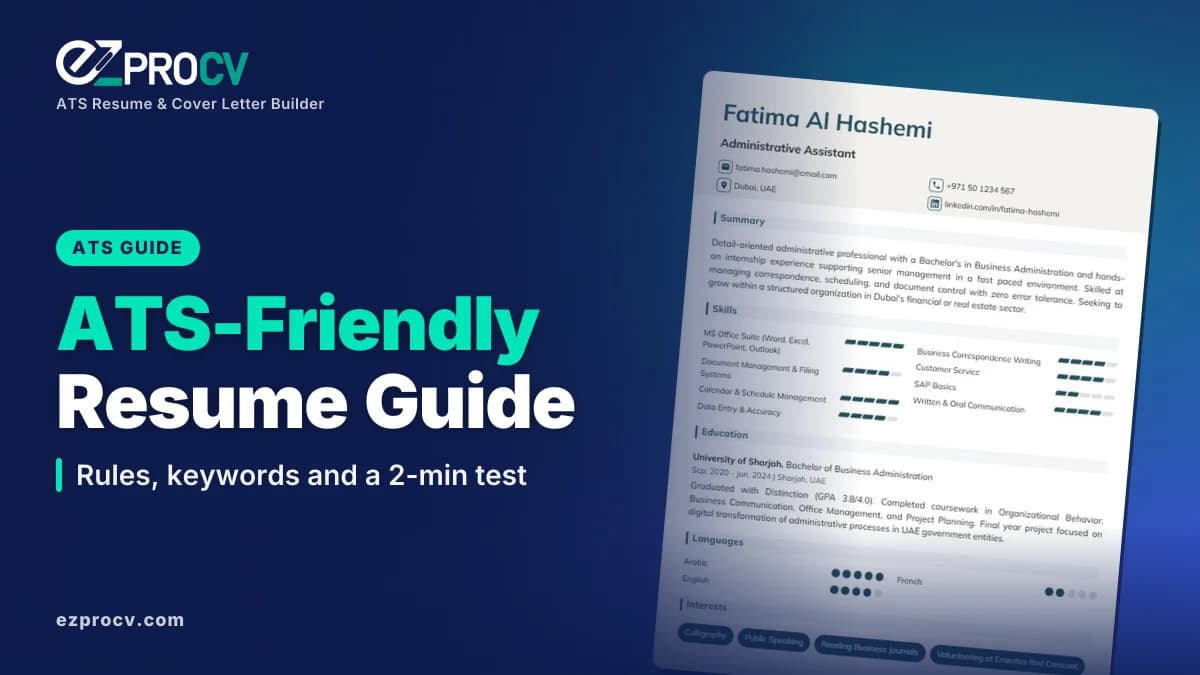
- Graphics and skill bars. Keywords inside images, icons or charts often can't be read.
- Acronyms only. Write "Certified Management Accountant (CMA)" once; recruiters search both ways.
- Listing skills you don't have. It wastes your interview.
- One keyword set for every job. Even similar roles use different tools and terms.
Build it in EZProCV
EZProCV's resume templates are designed for applicant tracking systems, with clean layouts, standard headings and a text-based PDF download, so every keyword you add stays readable. EZProCV doesn't scan or score your resume, so use the steps above to choose keywords, then edit them in with the live preview. Keep a master version and tailor a copy for each job. Watching your length? Our guide on how long a resume should be helps you trim.
Sources
- Greenhouse Support: Talent Filtering
- Greenhouse Support: Keyword suggestions
- MIT CAPD: Crafting an effective resume
- O*NET OnLine, US Department of Labor
- University of Sheffield Careers Service: Writing a CV
Frequently asked questions
How many keywords should a resume have?
There's no magic number. Aim to cover every must-have requirement in the ad that you genuinely meet, plus the most important nice-to-haves. For a typical job that's 10 to 20 distinct terms. Each core keyword should appear at least once in context, ideally in a bullet that proves it, and the most important two or three can also appear in your summary and skills section.
Should I hide keywords in white text on my resume?
No. Hidden white text is easy to spot: applicant tracking systems display the plain text of your resume, and recruiters see the keywords sitting in odd places. It looks dishonest and is a quick route to rejection. If you have the skill, write it visibly with proof. If you don't, leave it out and address the gap in your cover letter.
Do I need different keywords for every application?
Your core keywords for a given job title will overlap a lot, so keep a master resume with all of them. Then, for each application, check the ad for terms you haven't used, such as a specific tool, regulation or certification, and adjust the wording to match. Ten minutes of tailoring per application is usually enough.
Are soft skills useful as resume keywords?
Less than hard skills. Recruiters rarely search for "team player", but they do search for job titles, tools and certifications. Soft skills still matter to the person reading the resume, so show them through results ("Trained 8 new hires" shows coaching) instead of listing them as single words. Include a soft skill as a phrase only when the ad stresses it.
Does EZProCV check my resume for keywords?
No. EZProCV doesn't scan or score resumes. It gives you ATS-friendly templates and a text-based PDF that applicant tracking systems can read, so the keywords you add are stored as real text. Use the manual method in this guide to choose them; it's what a recruiter would do with the same job ad.