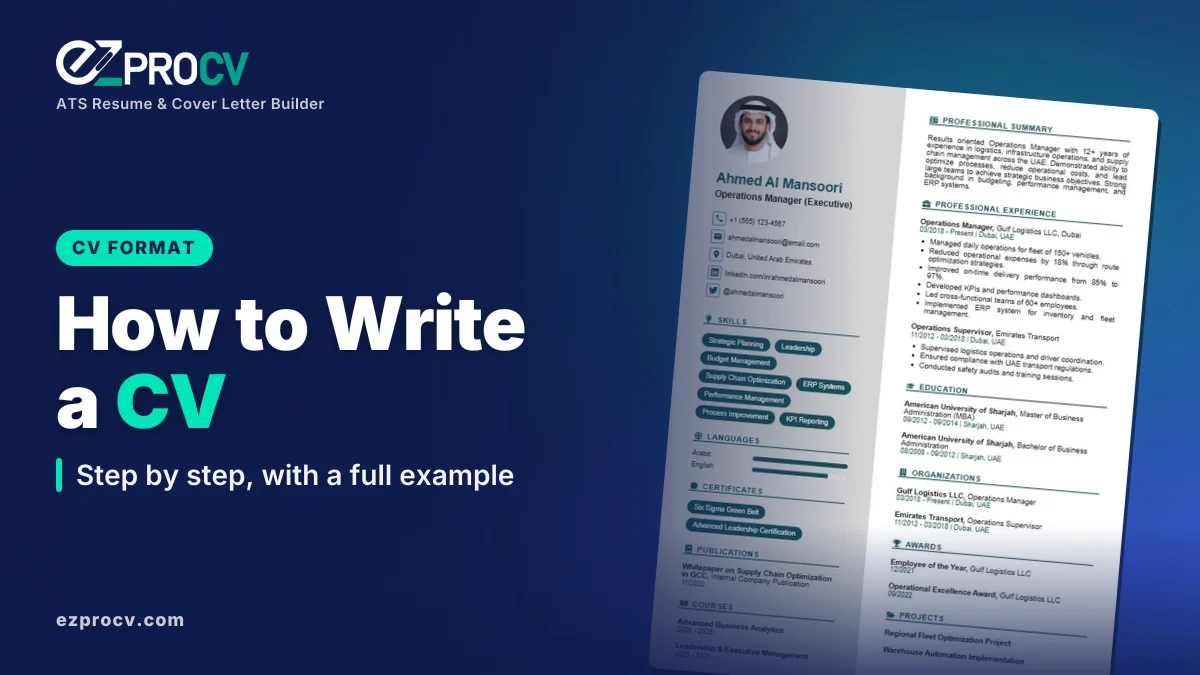
Quick answer: To write a CV, list your name and contact details, add a three to four line personal statement aimed at the job, then show work experience in reverse order with achievement bullets, followed by education, skills and optional extras such as languages. Keep it to two A4 pages, use a clear font, tailor it to each advert and adjust personal details to the country.
Knowing how to write a CV properly is the difference between a document that gets skimmed and one that gets you a call. Recruiters often decide in seconds whether to keep reading, so every line has to earn its place.
This guide is for anyone applying in the UK, Ireland, Europe, the Gulf, India, Pakistan, the Philippines or Africa, where "CV" is the standard job document. By the end you'll have every section written, a personal statement you can adapt, and a full example to model yours on.
What is a CV, and is it the same as a resume?
It depends on where you're applying. In the UK, Ireland, Europe, the Gulf, South Asia and most of Africa, a CV (curriculum vitae) is the normal one to two page document you send with a job application. In the US and Canada, that same document is called a resume, and "CV" means a long academic record of research, teaching and publications.
So if you're applying in London, Dubai, Lagos or Karachi, this guide is for you. If you're applying for a corporate job in New York or Toronto, the structure is almost the same, but call it a resume and keep it shorter. Our guide on the difference between a CV and a resume covers the details.
What sections should a CV include?
The UK government's National Careers Service lists contact details, an introduction, education, work history and references as the core sections. Graduate careers site Prospects adds skills and achievements, with interests as an optional extra.
Use this checklist:
- Contact details: name, phone, professional email, city and country, LinkedIn link
- Personal statement: three to four lines at the top
- Work experience: most recent job first
- Education: most recent qualification first
- Skills: technical skills, software, certifications
- Optional: languages, volunteering, projects, publications, interests
- References: usually a line or nothing (see the country table below)
Which comes first, education or experience? The National Careers Service suggests education first if you're early in your career and work history first once you have more experience. A rough rule: if you graduated in the last two years, lead with education.
How to write a CV, step by step
Follow these steps in order. Write the work experience before the personal statement if you get stuck; it's easier to summarize once the evidence is on the page.
- Collect your raw material: job titles, dates, employers, results, qualifications.
- Read the job advert and highlight the skills and requirements.
- Write each section using the guidance below.
- Cut anything that doesn't support the job you're applying for.
- Proofread, then ask someone else to read it.
Step 1: Contact details
Put your name at the top in a larger font. Underneath, one line with phone, email, city and country, and a LinkedIn URL. You don't need your full street address; Prospects notes that leaving it off is sensible if you post your CV online.
Amina Khan | +44 7700 900123 | amina.khan@email.com | Manchester, UK | linkedin.com/in/aminakhan
The National Careers Service advises UK applicants to leave out age, date of birth, marital status and nationality. Gulf and some South Asian employers expect more, which we cover below.
Step 2: Personal statement
The personal statement (also called a profile or summary) is three to four lines that say who you are, what you're good at and what you want next. Use this formula:
Who you are + years of experience + two strengths with proof + what you're looking for.
Customer service team leader with six years in retail banking. Cut average complaint resolution time from five days to two and trained 14 new advisers. Looking to move into a contact center operations role where I can improve processes at scale.
Recent civil engineering graduate (BEng, 2:1) with a 12-week site placement on a residential build. Confident with AutoCAD and site safety checks. Seeking a graduate site engineer role in the North West.
Registered nurse with eight years in emergency and ICU care across the Philippines and Saudi Arabia. BLS and ACLS certified. Seeking an ICU staff nurse position in Dubai, available within 30 days.
For dozens more, see our resume summary examples; the same lines work as CV personal statements.
Step 3: Work experience
For each job, give the job title, employer, city, and dates (month and year). Then add three to six bullet points. Start each bullet with a strong verb and show a result, not just a duty.
Before: Responsible for social media accounts.
After: Grew Instagram followers from 4,000 to 19,000 in 12 months by moving to a three-posts-a-week content calendar.
Before: Handled customer complaints.
After: Resolved an average of 35 customer complaints a day, keeping satisfaction scores above the team target for four straight quarters.
If you don't have numbers, describe scale (how many people, sites, clients) or outcome (what changed because you did it).
Step 4: Education
List the qualification, institution, location and year. Add your grade if it helps (a 2:1 or First in the UK, a CGPA in India or Pakistan). Graduates can add a line on a dissertation or relevant modules. Experienced candidates can shrink this to one line per qualification.
Step 5: Skills
Group skills so they're easy to scan. Use the exact names from the job advert where they honestly apply, because many employers search their applicant tracking system (ATS, the software that stores and filters applications) by keyword.
Technical: Excel (pivot tables, XLOOKUP), Power BI, SQL, SAP FI Languages: English (fluent), Urdu (native), Arabic (conversational) Certifications: ACCA Part-Qualified, PRINCE2 Foundation
Our guide to skills for a resume explains how to pick the right mix.
Step 6: Extras and references
Add sections only when they help: volunteering for career changers, projects for developers, publications for researchers. For references, the National Careers Service recommends writing "References available on request" rather than listing contact details.
How long should a CV be?
Prospects recommends no more than two A4 pages for most applications, with academic CVs allowed to run longer. One page is fine for students, part-time jobs and people with under two years of experience. Senior candidates with long careers can stretch to three pages, but only if every line is relevant.
If you're over two pages, cut older roles to one line each, remove "duties" bullets that don't show a result, and drop hobbies that say nothing about you.
How do CV rules change by country?
The core sections are the same everywhere. What changes is personal information, photos and length. Use this table as a starting point, then check the employer's advert.
| Region | Photo | Personal details | Typical length | References |
|---|---|---|---|---|
| UK and Ireland | No | Name and contact only | 2 pages | "Available on request" |
| Germany, Austria, Switzerland | Optional, still common | Some add date of birth | 1–2 pages | Employer letters often attached later |
| Wider Europe (Europass) | Optional | Varies by country | 2 pages | Rarely listed |
| UAE, Saudi Arabia, Qatar, Gulf | Common | Nationality, visa status, notice period often expected | 2 pages | Sometimes listed |
| India, Pakistan, Bangladesh | Varies | Some add date of birth, languages | 2 pages | Sometimes listed |
| Philippines | Common | Some add personal data | 1–2 pages | Often listed |
| Nigeria, Kenya, South Africa | Usually no | Name, contact, sometimes ID or nationality | 2 pages | Often listed |
| US and Canada (academic CV) | No | Name and contact only | As long as needed | Listed for academic roles |
For a country-by-country breakdown, browse our CV format guides by country, such as the UK CV format and the India, Pakistan and Gulf pages. Applying in the Gulf? Our UAE resume format guide covers photo, visa and notice period fields.
If you're applying across the EU, the European Commission's free Europass CV builder offers a familiar format that you can create in many languages, though no employer requires it.
A full CV example you can copy
Here's a complete two-page CV for a mid-level accountant applying in the UK. Swap in your own details and keep the structure.
AMINA KHAN +44 7700 900123 | amina.khan@email.com | Manchester, UK | linkedin.com/in/aminakhan
PERSONAL STATEMENT ACCA-qualified management accountant with five years in manufacturing and logistics. Rebuilt month-end close to finish in four days instead of eight and led budgeting for a £12m cost center. Looking for a senior management accountant role with a growing business.
WORK EXPERIENCE Management Accountant, Northline Logistics, Manchester | Mar 2022 – Present
- Cut month-end close from eight working days to four by automating 11 reconciliations in Excel and Power BI
- Prepare monthly management packs for the board, covering a £12m operating budget
- Identified £340k in duplicate supplier payments during a three-month spend review
- Supervise and train two assistant accountants
Assistant Accountant, Hartley Components Ltd, Bolton | Aug 2019 – Feb 2022
- Processed purchase and sales ledgers for 600+ active suppliers and customers
- Prepared VAT returns and supported two year-end audits with no adjustments raised
- Built a cash-flow forecast template still used by the finance team
EDUCATION ACCA Qualification, completed 2022 BSc Accounting and Finance (2:1), University of Salford, 2019
SKILLS Excel (advanced), Power BI, Sage 200, Xero, SAP FI, budgeting, forecasting, variance analysis
LANGUAGES English (fluent), Urdu (native)
REFERENCES Available on request
Notice what it does: every bullet has a number or a clear outcome, the personal statement names the target role, and nothing is there just to fill space.
Common CV mistakes
- One CV for every job. Generic CVs read as generic. Tailor the statement and top bullets each time.
- Listing duties instead of results. "Responsible for" tells the reader nothing about how well you did it.
- Wrong personal details for the country. A photo and date of birth can look out of place in London; leaving out visa status can slow you down in Dubai.
- Fancy layouts. Text boxes, icons and two-column designs can confuse some ATS software. Keep headings standard ("Work Experience", not "My Journey").
- Unexplained gaps. A short line is better than silence. The National Careers Service says a gap "is not a problem" but you may be asked about it, so explain it briefly.
- Typos. Job Bank Canada notes that a simple spelling mistake can give a negative impression. Read it aloud before sending.
Build it in EZProCV
The EZProCV CV maker gives you the sections above ready to fill in, with a live preview that matches the file you download. Pick a layout from the ATS-friendly templates, adjust fonts, colors and spacing, and download a text-based PDF for free. Applying in the Gulf? Turn on the optional photo, nationality, visa status and notice period fields. If you already have a CV in PDF or Word, you can import it and edit it instead of starting again.
Sources
- National Careers Service (UK): CV sections
- Prospects: How to write a CV
- European Commission: Create your Europass CV
- Job Bank, Government of Canada: How to write a good resume
Frequently asked questions
Should I write my CV in the first person?
Use an implied first person. Drop the word "I" and start sentences and bullets with a verb: "Led a team of six" instead of "I led a team of six". It reads faster and saves space. Avoid writing about yourself in the third person ("Sarah is a dedicated nurse"), which sounds odd when you are clearly the author.
Do I need a different CV for every job?
You need a different version, not a new document. Keep one master CV with everything on it, then for each application adjust the personal statement, reorder the bullets so the most relevant come first, and mirror the skills named in the advert. Ten minutes of tailoring usually does more than an hour spent on design.
What if I have no work experience for my CV?
Put education first and build the CV around what you have done: projects, internships, volunteering, part-time jobs, sports or society roles. Write each one like a job, with a short title, dates and two or three bullets that show a skill and a result. The UK National Careers Service also suggests hobbies can show skills when experience is thin.
Should I save my CV as a PDF or a Word file?
Follow the job advert first. If it does not say, a text-based PDF keeps your layout fixed and is accepted by the major applicant tracking systems. If an employer or recruiter asks for Word, send a .docx. Name the file clearly, such as "Amina-Khan-CV.pdf", rather than "CV final v3".
How far back should my CV go?
Cover roughly the last 10 to 15 years in detail. Older roles can be cut or grouped into one line under "Earlier career" with the employer names and job titles only. Keep older jobs in full only when they are directly relevant to the role you want, such as earlier experience in the same industry.