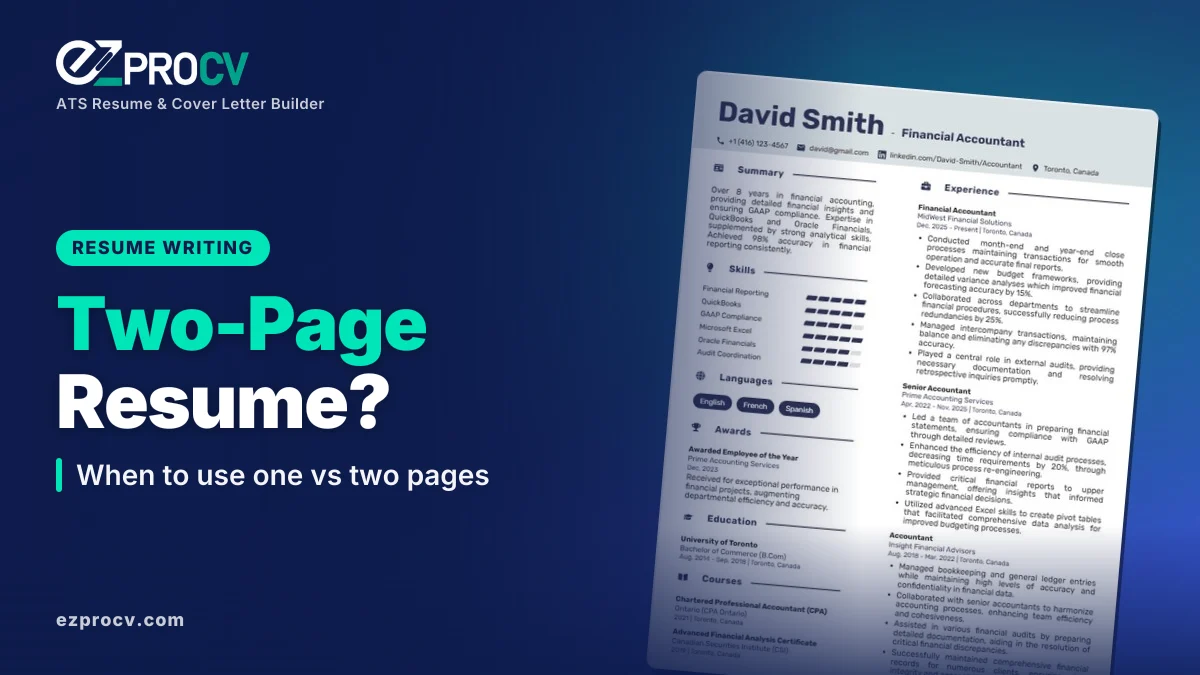
Quick answer: Use a two page resume when you have roughly seven or more years of relevant experience, a technical or senior role with detail recruiters need, or you are applying in markets like the UK, Australia or the Gulf where two-page CVs are normal. Students, graduates and most early-career applicants should stay on one page. Fill page two at least halfway and keep the strongest content on page one.
Few resume questions cause as much second-guessing as page count. Some people cram fifteen years onto one page with tiny fonts; others pad a two page resume with filler because they think longer looks more experienced. Both approaches hurt.
This guide is for anyone deciding between one and two pages, whether you are a graduate in Manila, a mid-career engineer in Toronto or a manager applying in Dubai. You will get clear decision rules by experience level and country, ways to make page two worth reading, and formatting tips that keep a two-page resume tidy.
For the bigger picture on length, including CVs and academic documents, see our guide on how long a resume should be.
Is a two-page resume acceptable?
Yes, in the right situation. There is no universal rule, and official guidance generally sets two pages as a maximum, not a minimum:
- Canada's Job Bank advises you to limit your resume to two pages.
- The US Office of Personnel Management (OPM) set a two-page limit on federal resumes submitted through USAJOBS starting September 27, 2025. Under OPM's guidance, an applicant whose only resume is longer than two pages is ineligible for further consideration, so federal applicants must stay within two pages (as of October 2026; check each announcement).
- Harvard's career services describes a resume as a concise, informative summary and does not set a page number, focusing instead on being easy to skim.
The real test is relevance. A two-page resume is fine when every line on page two helps the recruiter decide to interview you.
How do you decide between one and two pages?
Use these rules of thumb. They are guidance, not law, so adjust for your field.
| Your situation | Pages | Why |
|---|---|---|
| Student, graduate or first job | 1 | Not enough relevant history to fill two well |
| 1 to 6 years of experience | 1 (sometimes 2) | Most fit on one page if you edit firmly |
| 7 or more years of relevant experience | 2 | Room for multiple roles with results |
| Manager, director or executive | 2 | Leadership scope, budgets and results need space |
| Technical roles with certifications, tools or projects | 2 | Recruiters screen for specific skills |
| Career changer | 1 to 2 | Keep only transferable experience |
| Academic, research or medical role | A CV, often longer | Publications and grants are expected |
| US federal job (USAJOBS) | 2 maximum | OPM limit |
A quick test: if you are cutting relevant achievements to fit one page, go to two. If you are adding hobbies and old duties to fill two, go to one.
Does resume length differ by country?
Yes, and this matters if you are applying abroad.
| Country or region | What is normal |
|---|---|
| United States | One page for early career; two for experienced professionals; two maximum for federal jobs |
| Canada | One to two pages; Job Bank advises two maximum |
| UK and Ireland | Two pages of A4 is the common standard for a CV, even for many graduates |
| Australia and New Zealand | Two to three pages is common for experienced applicants |
| Germany and much of Europe | One to two pages, often with certificates attached separately |
| Gulf (UAE, Saudi Arabia, Qatar) | Two pages is common; personal details such as nationality and visa status take extra space |
| India and Pakistan | Two pages for experienced roles; freshers often use one |
Country guides go deeper: see the UK CV format and the US resume format.
What should go on page one versus page two?
Recruiters read page one most closely. Put your strongest evidence there.
Page one:
- Header with name, title and contact details
- A short summary with your best one or two results
- Core skills that match the job ad
- Your current or most recent role, with three to five accomplishment bullets
- Your previous role, if it is highly relevant
Page two:
- Earlier roles, with fewer bullets each
- Education
- Certifications, licences and training
- Selected projects, publications or awards
- Languages and relevant technical tools
- Volunteer work, if it shows relevant skills
How do you make page two worth reading?
A weak page two can undo a strong page one. Make it earn its place:
- Fill at least half of it. Two or three lines on page two look like a formatting accident.
- Keep results in every role. Even older jobs should have one accomplishment, not a duty list.
- Trim old history. Jobs from more than 10 to 15 years ago can be listed with one line each or grouped under "Earlier experience." Our guide on how far back a resume should go covers this in detail.
- Add proof sections. Certifications, projects and awards are useful page-two content because they are easy to scan.
- Do not repeat page one. Each skill or achievement should appear once, in its best context.
Example of an older role condensed for page two:
Earlier experience Accounts Assistant, Gulf Trading LLC, Dubai (2012–2015): Reconciled 40+ supplier accounts monthly and helped introduce the company's first accounting software. Junior Bookkeeper, Rahman & Co., Karachi (2010–2012)
How should you format a two-page resume?
- Name and page number on page two: add "Priya Nair, Page 2" as plain text at the top of page two. Do not use the Word header area. Greenhouse, a major applicant tracking system vendor, lists contact details in headers and footers among the causes of unsuccessful resume parsing.
- Avoid splitting a job across pages when you can. If a role must split, break it between bullets, not in the middle of the job title.
- Keep one consistent layout. Same fonts, margins and heading styles on both pages.
- Use a readable font size, usually 10 to 12 point for body text. See our guide to the best font for a resume.
- Use white space, not tiny fonts, to manage length.
- Save as a text-based PDF unless the employer asks for Word.
Common mistakes with two-page resumes
- Padding to reach two pages. Hobbies, references and old duties do not add value.
- Shrinking fonts to stay on one page. If it needs 8-point text, it needs two pages.
- Putting the best content on page two. Recruiters may never get there.
- A near-empty second page. Either fill half or cut back to one.
- Different layouts on each page. It looks like two documents.
- Ignoring employer limits. If an application says two pages, a third page can disqualify you.
Build it in EZProCV
Choose a layout from the EZProCV resume templates and watch the live preview as you write. It shows exactly where page one ends, so you can move your strongest content up and see whether page two is worth keeping. Download a text-based PDF that matches the preview, free.
Sources
- Job Bank (Canada): How to write a good resume
- US Office of Personnel Management: Agency guidance on the two-page limit on resume length
- Harvard FAS Mignone Center for Career Success: Create a strong resume
- Greenhouse support: Unsuccessful resume parse
Frequently asked questions
Is a page and a half resume okay?
Yes. A resume that fills one full page and at least half of the second is common and reads well. What looks weak is a second page with only two or three lines, which suggests you could not edit. If you have a few lines spilling over, tighten bullets or spacing to get back to one page. If you have half a page or more, keep two.
Should a two-page resume be printed double-sided?
If you bring printed copies to an interview, print each page on a separate sheet, single-sided, so the interviewer can lay them side by side. Put your name and "Page 2" at the top of the second page as ordinary text, so it stays connected to page one if the sheets are separated. Most applications are digital, so this matters mainly for in-person interviews and career fairs.
Do applicant tracking systems penalize two-page resumes?
Page count is not a parsing problem. An applicant tracking system reads and stores your text so recruiters can search and review it, and the ATS vendor documentation we reviewed lists formatting and file-size issues, not page count, as causes of parsing failures. The real limits are set by employers: for example, US federal jobs on USAJOBS have accepted only two-page resumes since September 2025. Focus on clean formatting and relevant content rather than page count alone.
Can a student or graduate use a two-page resume?
It is rarely needed. Most students and recent graduates can fit their education, internships, projects and part-time jobs on one page, and recruiters hiring graduates expect it. Exceptions include research-heavy graduates with publications, people with substantial work experience before university and applications in countries where two-page CVs are standard for everyone, such as the UK.
Is three pages ever acceptable?
For most private-sector jobs, three pages is too long. It can be acceptable for senior executives with long track records, academic and medical CVs, and some technical consulting roles with project lists. Even then, check the employer's instructions first. US federal applications are capped at two pages, and Canada's Job Bank advises limiting a resume to two pages.